# Why Rust Is Gaining Attention for Secure Software Development
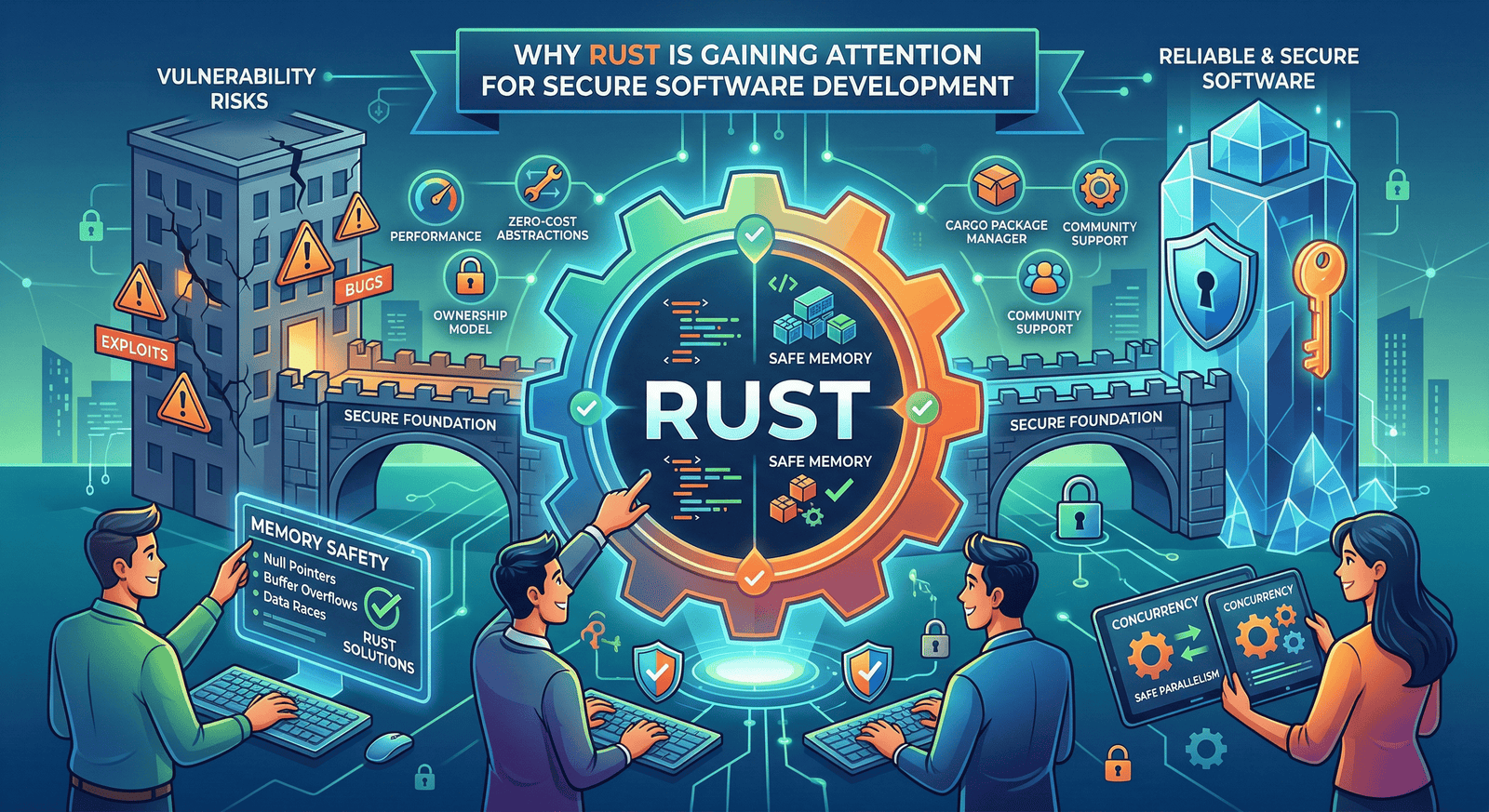
Rust has gained strong attention in recent years because it addresses one of the biggest challenges in software engineering: building fast systems without sacrificing safety.
Traditional high-performance languages often give developers full control over memory, but that flexibility can also introduce serious risks such as memory leaks, crashes, and vulnerabilities. Rust was designed to solve this problem by providing strict memory safety rules during compilation.
This means many common errors are prevented before the software even runs.
Rust is increasingly used for:
- System-level software
- Security-sensitive applications
- Performance-critical tools
- Infrastructure services
- Browser engines
- Command-line tools
A major reason developers trust Rust is that it delivers performance close to low-level languages while reducing many traditional risks.
Rust offers several important advantages:
- Strong memory safety
- High execution speed
- Low resource usage
- Reliable concurrency
- Modern tooling
Large technology companies are already adopting Rust in specific projects because security requirements continue increasing.
For example, Microsoft and Google have both explored Rust for improving software safety in critical systems.
Rust is especially attractive in situations where software must remain stable under heavy load.
This includes:
- Network services
- Security tools
- Embedded systems
- Infrastructure components
Another reason Rust is growing is long-term maintainability. Developers often find that once Rust code is written correctly, future bugs become easier to control.
Although Rust has a steeper learning curve than many beginner-friendly languages, businesses value it because fewer runtime failures can reduce long-term operational risk.
In 2026, Rust continues to grow because secure software is no longer optional. As digital systems become more complex, languages that combine speed and safety become increasingly valuable.




No comments yet. Be the first!